Tuesday, 30 January 2018

Beech - Fagus Sylvatica

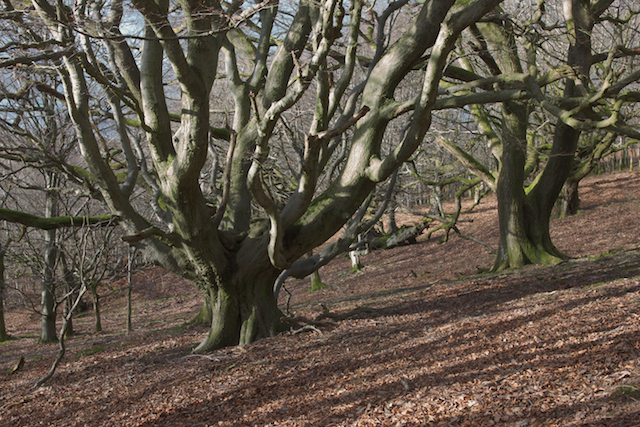
Derelict beech pollard, Black Mountains
On a recent trip to the Black Mountains I passed by a number of impressively large derelict beech pollards that reminded me to look up the latest research into unravelling the history of beech in the British Isles. There was once a time when beech was believed to be native only to southern England. This paradigm has had to be revised in light of beech charcoal excavated by archaeologists in secure contexts and beech pollen found in waterlogged sediments viz drowned forest beds in the Severn estuary radiocarbon dated to around 6,000 years ago. The late Oliver Rackham produced a distribution map for beech in the New Naturalist Woodlands  and it has been reproduced in a comprehensive monograph on beech Packham, John R., et al. "Biological flora of the British Isles: Fagus sylvatica." Journal of Ecology 100.6 (2012): 1557-1608 

Presumed distribution of beech (fagus sylvatica) from Packham, John R., et al. "Biological flora of the British Isles: Fagus sylvatica." Journal of Ecology 100.6 (2012): 1557-1608.
A google search threw up the news that research had established that beech in Scotland was native in origin.


Moving onto Google scholar and finding anything related to recent research publications - with open access - on beech colonisation in Britain has proved challenging, vague generalisations seem to apply. All the current research seems to be centered on mainland Europe. Beech is apparently a thermophile and is used to reconstruct and model quaternary environments and with a widespread European distribution underpins some avenues of research. There are a plethora of papers attempting to model the distribution and colonisation rates of beech across Europe during the pleistocene/holocene and seems to entail postulating numerous glacial refugia. The glacial refugia influence the rate of colonisation, with increased rates to account for the bypass routes around significant mountain ranges, where colonisation rates are improbably high then alternative hypotheses need to proposed such as: beech mast transported by northward flowing rivers, animal dispersal, anthropogenic assisted distribution etc. One notable paper provides compelling evidence from radiocarbon dated pine, oak and beech charcoal, possibly indicating a glacial refugia in the Harz mountains and poses some interesting questions of colonisation and climate models Robin, Vincent, et al. "Too early and too northerly: evidence of temperate trees in northern Central Europe during the Younger Dryas." New Phytologist 212.1 (2016): 259-268. The paper provoked a comment and a reply. An interesting exercise and an insight into an ongoing area of much debate.

Saturday, 6 January 2018

1st outing 2018

Conscious of the fact that hill walking had been neglected and my fitness levels had dropped alarmingly over a slothful festive period, a trip was needed to the hills. Inspiration was provided by a weather forecast that offered some hope for quality lighting with the caveat of weather warnings and the Brecon Beacons National Park would be the destination. Travelling down the A40 to Abergavenny revealed that the higher ground was obscured by low cloud, sigh, although the cloud was breaking up over the Usk valley. The Black Mountains would offer some relative shelter and the Ffridd/Coed cae potentially the best photographic opportunities given the weather and options to go higher or lower depending on how the weather panned out.


Opting to head first to the higher ground revealed how desperate the weather was, happily common sense prevailed at the futility of making photographs in a decidedly 'fresh' wind, horizontal rain and accompanying hill fog. I later learnt that Met Office weather stations in low lying Herefordshire recorded gusts to 60 mph. So a descent to the relative calm of the Ffridd/Coed cae and a wait for some light to illuminate a magnificent derelict pollarded oak against incoming rain clouds before descending down to an area of woodland that provided an insight into the historic woodland management in the form of low cut pollards and veteran derelict coppice stools. It was then a case of waiting for sunshine to break through the clouds and illuminate the woodland against the backdrop of a dark sky.


Pollarded beech (Fagus sylvatica) and oak (Quercus petraea)


All in all it was a good trip with some welcome low angled light, weather, some fresh air and some much needed exercise.

Tuesday, 2 January 2018

Abstracting woodland

The last quarter of 2017 witnessed the extensive use of 100mm and 180mm macro lenses to record epiphytes at minimum focus distances in woodland environments and to avoid getting distracted from macro subject matter sometimes only those lenses were carried. So despite the good intentions the opportunity also arose to also explore abstracts of woodland subject matter and intimate views of the woodland.

180mm ~ Oak, Speech House woodland, Forest of Dean
100mm ~ Oak, Speech House woodland, Forest of Dean
100mm ~ Dead Holly, Speech House woodland, Forest of Dean
Decorticated wood was one source of inspiration and some low level light illuminating Holly berries was another.

180mm ~ Holly, Speech House woodland, Forest of Dean

Some 'epiphytescapes' were also attempted.

100mm ~ Veteran oak, Speech House woodland, Forest of Dean

100mm ~ Fallen oak, Speech House woodland, Forest of Dean
Finally on the last trip of 2017 a suitably blurred woodland background for a coral lichen coated tree trunk was chanced upon.

180mm ~ Coral lichen (Sphaerophorus globosus), Cnwch Wood, Elan Valley

The opportunity to abstract the woodland environment allowed some welcome relief from the travails of  pure macro photography and images made of subject matter that I wouldn't necessarily have made with the usual landscape lens line-up.

Friday, 29 December 2017

2018 Predictions

First the autopsy on 2017's risible efforts:

1. Harsh Light, the new black
Not yet.

2. Post-truth landscape photography
The caveat I tacked onto the prediction confirms that post-truth landscape photography was indeed endemic some years before Brexit and Trump came onto the scene.

3. Auteur theory
Nope.

So the annual irreverent, wildly uninformed predictions on landscape photography in 2018 are:

1. Integrity
An often controversial, sometimes farcical, much hyped UK landscape photography competition pandering to the lowest common denominator will award the major prizes to photographs of actual scenic landscapes sans pets and livestock by photographers stood on terra firma with their camera in close proximity.

2. Kübler-Ross Award
In what is becoming a firm fixture in the landscape photographers calendar those rejected from a much hyped UK landscape photography competition pandering to the lowest common denominator, take to social media to lament their rejection and seek solace in their echo chamber. In recognition of their craven desire for '15 mins of social media fame' there will be #KüblerRossaward to showcase their reaction.

3. Manual focus zoom lenses
In order to deprive photography media of filler articles 'How to manually focus autofocus lenses'. A lens manufacturer will announce a family of 100% manual focus, high quality F4 zoom lenses for the landscape photographer. Featuring silky smooth focusing ring, a calibrated focus scale c/w infinity hard stop, aperture ring, rugged build quality, environmental sealing and resolution of fine detail.

Sunday, 24 December 2017

Lichens of ancient deciduous woodland

There is something compelling about native woodland where twigs, branches, and trunks are mantled with epiphytic flora. The juxtaposition of lichens, liverworts, mosses and polypody ferns creates a visual kaleidoscope of patterns and colours when walking through these unique woodlands. The complexity is not just visual but also on an ecological level where similar adjacent trees can have widely divergent epiphytic flora with one tree dominated by liverworts and mosses, whilst an adjacent tree has crustose and leafy lichens and another has mosses and leafy lichens. This apparent random distribution of species, as far as I am aware, is the exploitation by species of microhabitats determined by humidity/light levels/bark character/air pollution level etc. Whilst mosses and liverworts create their own unique primordial atmosphere in a woodland, the patina of 'hoary' lichens generates the atmosphere evocative of antiquity.

Oak woodland with a diverse assemblage of epiphytic lichens ~ Coille Dhubh,  Shieldaig Forest


Early 19th century oak plantation with a poor assemblage of epiphytic lichens ~ Nagshead Plantation, Forest of Dean.
It just so happens that some lichens are indicative of ancient old growth woodland, identified by the commendable detective work of ecological historians and a significant amount of survey work incorporating careful observations of habitats. In many areas of the British Isles, lichens of old woodland are glacially slow to colonise new woodland and this is illustrated from studies in the New Forest, where 200-300 years was sufficient time for most lichens to recolonise undisturbed woodland. Although the ancient dry bark lichen community (Lecanactidetum premneae) requires 400 years to recolonise after clear felling. The ecological impact of clear felling woodland in the 17th Century is only now being rectified.

The Revised Index of Ecological Continuity (RIEC) developed in 1976 lists 30 indicator lichens to grade the ‘ancient woodland’ interest of deciduous woodlands throughout the whole of Great Britain and Ireland :
1. Anisomeridium ranunculosporum
2. Arthonia vinosa 
3. Biatora sphaeroides (Current Taxon Name: Mycobilimbia pilularis)
4. Catinaria atropurpurea 
5. Cresponea premnea 
6. Degelia atlantica/or Degelia plumbea/or Parmeliella triptophylla 
Degelia sp. (atlantica?) and Lobaria pulmonaria on a mature Ash tree ~ Sleat, Isle of Skye
7. Dimerella lutea
8. Enterographa crassa 
9. Lecanographa lyncea 
10. Lobaria amplissima
11. Lobaria pulmonaria
Tree lungwort (Lobaria pulmonaria) ~ Coille Dhubh, NW Highhlands, Scotland
Green satin lichen (Lobaria virens) - Loch a' Mhuilinn SAC

Sticta limbata ~ Meirionnydd Oakwoods SAC
28. Sticta fuliginosa/or Sticta sylvatica
29. Thelopsis rubella
30. Thelotrema lepadinum

A formula has been developed to rank the degree of ecological continuity of woodland from the species density of REIC lichens in a square kilometre of woodland:
  • 15 or more RIEC lichens and there is "clear evidence of an ancient woodland with a long history of ecological continuity; the woodland has never been clear-felled or extensively coppiced, although trees may have been felled on a selective basis".
  • 10 - 14 REIC lichens indicates there is "strong evidence of ecological continuity". 
  • 6 - 9 RIEC lichens indicates there is "evidence of some degree of ecological continuity".
  • 0 - 5 RIEC lichens indicates "no indication of ecological continuity; the woodland is either a plantation or has been clear felled and regenerated, or coppiced."
There are a number of caveats with the RIEC as it assumes levels of air pollution have not negatively impacted on the lichen population, was based largely on those Lobarion or Lecanactidetum communities found in the New Forest and lowland English parklands and some lichens are geographically restricted.

Screenshot of a map showing areas where each Lichen Index for Ecological Continuity for deciduous woodlands is appropriate http://www.britishlichensociety.org.uk/about-lichens/indices-ecological-continuity-woodland-epiphytic-lichen-habitats

Since 1976 further insights into lichens and their habitats has been been elucidated with indices developed to cater for regional distributions and rating the conservation value of woodland:
New Index of Ecological Continuity (NIEC)
West of Scotland Index of Ecological Continuity (WSIEC)
Eu-Oceanic Calcifuge Index of Ecological Continuity (EUOCIEC)
East of Scotland Index of Ecological Continuity (ESIEC)
West Ireland Index of Ecological Continuity (WIIEC)

Tree lungwort (Lobaria pulomaria),  Green satin lichen (Lobaria virens) and Bark barnacle lichen (Thelotrema lepadinum)  on a mature oak ~ Tower wood, Killarney National Park 

Many of my local woods in the Forest of Dean and Wye Valley are designated as ancient in origin and sadly clearly demonstrate the effects of historic air pollution AND adverse woodland management. Centred on a coalfield and downwind of the Bristol and South Wales coalfields the area has been subjected to pollution from coal burning associated sulphur dioxide emissions and 'acid' rain. The woodland management has seen extensive coppice management for charcoal and then conversion to broadleaf and evergreen plantations. The Nagshead Plantation in the Forest of Dean illustrates the slow rate of lichen recolonisation, it was clear felled and replanted with oak in the early 1800's and a Forestry Commission handbook on lichens (1989) records that the Nagshead Enclosure has no lichens indicative of old woodland and 16 other epiphytic lichens. The same handbook has a listing for old growth oak woodland with glades in the New Forest with an impressive 20 REIC lichens and 300 epiphytic lichens recorded.

Bark barnacle lichen (Thelotrema lepadinum) indicator of 'Old woodland', Speech House Oaks SSSI, Forest of Dean
Consulting the NBN Atlas indicates that the Speech House Oaks SSSI is the richest area in the Forest of Dean for REIC lichens:
None of which are macrolichens, which means you need to get up very close with a hand lens to see any detail and then some competence to then identify them. Which is why there is only one image of the bark barnacle lichen to illustrate the Speech House Oaks SSSI REIC community. Taking an interest in the lichens at least provides an opportunity to appreciate the micro-habitats of woodland and an insight into their ecological continuity.


Friday, 24 November 2017

An autumn narrative

A forecast of rain clearing with some brief intermittent sunshine and low winds before a more extensive weather front arrived presented the opportunity for a quick outing to simply capture autumnal colour in the woodland of the Forest of Dean. Wetted trunks of beech trees and leaves with contre jour lighting would be just the ticket. So a 10 min car journey, 10 minute walk from the car, set up, wait a few minutes for a break in the cloud and hey presto.


Wednesday, 22 November 2017

Mother trees and forests

If you have a spare 20 mins it is worth watching Professor Suzanne Simard providing insight into the layers of complexity in forests.
"This fascinating talk presents the scientific research that shows the interconnectedness of life in the forest ecosystem. It takes us beneath the forest floor where we learn how trees are communicating and exchanging resources. Going beyond the simple view of a forest as a resource to be exploited, it presents the forest as a complex network of life. Her examination of the relationships that make up the complexity of nature present compelling support for the idea that “We are all one” Suzanne Simard studies the surprising and delicate complexity in nature. Her main focus is on the below-ground fungal networks that connect trees and facilitate underground inter-tree communication and interaction. Her team's analysis revealed that the fungi networks move water, carbon and nutrients such as nitrogen between and among trees as well as across species. The research has demonstrated that these complex, symbiotic networks in our forests -- at the hub of which stand what she calls the "mother trees" -- mimic our own neural and social networks. This groundbreaking work on symbiotic plant communication has far-reaching implications in both the forestry and agricultural industries, in particular concerning sustainable stewardship of forests and the plant’s resistance to pathogens. She works primarily in forests, but also grasslands, wetlands, tundra and alpine ecosystems." 

mhf.kfy