Showing posts with label landscape photography. Show all posts

Tuesday, 10 July 2018

Graian Alps (Alpes grées) trip report -1

Back in 2014, the last week of June was spent exploring one area of the Graian Alps and very impressive it was too. The benefits of staying in a refuge allowed dawn and dusk photography sans the drama of ascent/descent in head torch light, the wild flower meadows were in full bloom as were alpine flowers on higher ground. Some relatively accessible routes to higher vistas were recced for future visits and those with high potential noted for a future visit.
Periglacial relict blockslope and glaciated mountains
Four years on and time for a revisit with an itinerary that involved staying in a couple of refuges to maximise dawn/dusk opportunities, wet weather itineraries in the side valleys with melt water torrents and multi coloured boulders, the best photographic set aside for a couple of trips to 3,000 metre peaks, sunny weather for wild flowers, geomorphology and geology. I had also been aware of reports of heavy snowfall in the Alps throughout the winter of 2017/18. A hotel had been initially booked in a central location and from this a series of recce's would be made to establish what condition the higher elevations were in, before moving on.

Avalanched snow blocking the path
It became apparent that snow was still lying to some depth and extent at higher elevations on north facing aspects, though not so much on south facing aspects. Rivers and streams were swollen with melt water. Also evident were avalanche debris of snow, trees and rock, the smell of pine resin downwind of an avalanche tract was to become a good indicator of difficulties ahead in some side valleys. Some minor roads were still blocked by avalanche debris and one road closed as a section and slid down the mountainside. On the approach road to a high pass an impressively large loading shovel was on duty clearing the road of rock debris as it melted out from avalanche cones, elsewhere construction operations were effecting repairs to roads.  Routes to two high refuges and the way forward to high cols raised the bar for adventure beyond our comfort zone and Nic was more than happy to base our stay in the hotel for the duration, it's a hard life.

The odd cloud according to the weather forecast
Whilst the French IGN 1:25,000 maps are very good, the weather forecasts were decidedly poor: thunderstorms never materialised, neither did rainfall, cloud cover was a lottery and the temperatures much higher than forecast e.g mid 20's turned into mid 30's. With numerous caveats out of the way the next post will concentrate on the good things.

Saturday, 30 June 2018

May wrap up and June in the Alpes grées

To recap March and April weather wasn't the best delaying many flowering plants although beech (fagus sylvatica) flushed early. Then May reverted to above average warmth, or as the Met office put it:
"The persistent sun and warmth meant that this was the highest average maximum temperature on record for May."

https://www.metoffice.gov.uk/climate/uk/summaries/anomacts

https://www.metoffice.gov.uk/climate/uk/summaries/anomacts

The record (UK) warmth accelerated spring and overhead skies were mostly clear with just the odd band of heavy rain or thundery showers. The insects were especially tiresome with midges and mosquitoes out in biblical numbers in the shade and shelter of the woods. In oakwoods bracken (Pteridium aquilinum) emerged just as bluebell carpets came into flower. Suffice to say that this was not a vintage spring for my photography. Still there was a trip revisiting the Graian Alps to offset the despair.

Graian Alps ~ June 2018


Saturday, 19 May 2018

Ramsons carpets

Two recent woodland trips provided the inspiration for this post on ramsons (Alium ursinum). The first trip was an afternoon recce for some uncommon woodland flora when a visually compelling ramsons carpet was chanced upon in less than ideal lighting. Another location identified and added to the seemingly ever lengthening 'to visit under more idealised lighting' list.


To increase the chances of finding ramsons carpets an appreciation of their ecology is useful and a Hungarian research paper provides some useful insight into the habitat requirements amongst other things:
"In spite of its broad distribution across continents, and its occurrence as a weed, the species cannot be considered as a generalist. Several authors have classified it as a habitat specialist, having a rather narrow range of ecological tolerance (Grime et al. 1988, Kevey 1977, Rychnovská and Bednář 1998). A. ursinum is particularly sensitive to the availability of water. It requires a mesic soil, which is well-drained. Both drought and waterlogging are unfavourable (Csiky et al. 1999, Grime et al. 1988, Kevey 1977, Rychnovská and Bednář 1998, Trémolières et al. 2009, Tutin 1957). Sufficient humidity in the air is also crucial for survival (Kevey 1977, Kovács 2007)."
"The species strongly prefers the forest floor; it can rarely be found outside of a forest (Grime et al. 1988), only in some places with high, evenly distributed precipitation (Tutin 1957) or along rivers or streams (Kevey 1977)." 
"The plant requires a nutrient-rich soil (Tutin 1957)"
"A. ursinum is sensitive to the pH, missing from base-poor sands and mor soils (Tutin 1957). Falkengren-Grerup and Tyler (1993) demonstrated experimentally that mor (pH 3.6) inhibited the production of new roots. Tutin (1957) estimated the tolerated pH range from 5.5 to 7.9; Grime et al. (1988) narrowed it to 6–7.5" 
Extracts taken from Oborny, B., Botta-Dukat, Z., Rudolf, K. and Morschhauser, T., 2011. Population ecology of Allium ursinum, a space-monopolizing clonal plant. Acta Botanica Hungarica, 53(3-4), pp.371-388.
Ransoms are an indicator species of ancient woodland and some online detective work cross referencing national ancient woodland inventories e.g. Wales and England, against a relevant geology map will identify candidate sites of ancient woodland overlying calcareous bedrock. It is then a case of recceing the candidate woods.


The second trip was one made specifically to photograph a riparian carpet of ramsons within the Lower Wye Valley AONB on a rare day with overcast skies, the weather in May, thus far, has been mostly clear blue skies and sunshine. The woodland is designated as ancient semi natural and has outsize coppice stools of alder, ash, wych elm and hazel with a ground flora community of ancient woodland indicator species.

Tuesday, 15 May 2018

A spring woodland trip

A forecast of heavy overnight rain with clearing skies, negligible wind and the chance of mist, was the inspiration to set the alarm clock for a dawn outing. A bluebell wood recced on an evening visit a few days before would be the destination.
Wild boar foraging


Entering the wood just before sunrise and it became apparent that a) there was no ground mist, nor indeed any other type of mist and b) a sounder of wild boar had descended en masse to forage in the bluebell carpet in the area of wood that I wanted to photograph. Sigh. There were no signs of leaves or flower stalks sans bulbs, the boar seemed interested in something else and the bluebells collateral damage. Taking stock of the situation and the overnight rain had enlivened the mosses, wetted the leaf litter and the wind was negligible, so Plan B would be a visit to a scowles woodland 10 minutes drive away and hopefully the flora would be in flower.

Ramsons carpet

On the drive to the scowles wood I passed by patches of ground mist on fields and on the walk in there was a ground mist in the meadow adjacent to the wood. No mist in the wood though and reinforcing my view that woods have their own microclimate. Nevertheless there was some nice mist filtered light over a ramsons carpet and also deeper into the wood.


The Ransoms whilst in full flower at the wood edges were only beginning to flower in some parts of the wood where beech trees had leaf flushed well before the other canopy trees of lime and ash.

In the scowles where yew forms the understorey then it's the domain of bryophyte communities and just a few vascular plants.


It did appear to my eyes that where a canopy gap allowed morning sunlight onto the woodland floor there was a noticeable increase in woodland plants.


The light all too quickly became too harsh for effective photography and the remainder was spent investigating the wood for less common plants and enjoying the chorus of bird song.


Thursday, 22 March 2018

A circuit in the Black Mountains

After a grim period of weather the Met Office served up a compelling weather forecast for a wander onto the hills.


Taking into account the wind direction, likelihood of showers and sunset light, the Black Mountains were chosen and a circuit of Cwm Banw. Nic was enthused enough to accompany me. Ascending through the fields a local farmer was met and a brief chat about the impact of Storm Emma elicited that about 2 feet of snow had fallen and drifted to very impressive depths, all the minor roads were blocked for a few days and it had taken the farmer 15 hours to dig a route to get feed to livestock, a journey that would normally take 5 minutes. To illustrate the severity of the weather event, 2 weeks on there were still snow patches a few feet deep in the sunken holloway on the path up. Reaching the open moorland and sadly the weather changed from blue skies, fluffy white clouds and warm sunshine to more ominous looking clouds, much less blue sky and the donning of winter jackets.

Landforms and patterned vegetation in the Black Mountains


The Black Mountain environs exhibit a curious mixture of landforms from plateau surfaces that suggest relict planation surfaces 10's of millions years old to those attributable with more confidence to repeated glaciations in the pleistocene. Areas of patterned vegetation may be associated with underlying superficial deposits that have been subjected to periglacial processes. Illuminated by more desirable light these would have been more apparent and a mental note was made to revisit at a more optimal time of day and year.

Squall lighting and open moorland


The best lighting occurred on the approach to Pen Allt-mawr where foreground composition was limited to moorland vegetation and a simple demonstration on the why side lighting is preferable for saturated colour.
The approach to Pen Allt-mawr

On reaching the summit of Pen Allt-mawr the squall hit with rain quickly turning to sleet and the novelty of ice coating any exposed clothing. Nic was less than impressed. Still there were grand views to the west until the hill fog obscured everything. I raised the prospect of waiting for the squall to pass and received the look of mutiny from Nic. The planned high level exposed plateau circuit of Cwn Banw walking into wind driven sleet held little appeal and instead we made our way back to the car via a lower, less exposed route. A consultation of the OS map indicated a stream would need to be crossed and that stream would no doubt be swollen. So the return route would keep to a high level and basically contouring, which explains why several relict vegetated periglacial boulder lobes were traversed and on another day these would have presented some photographic foreground interest rather than tiresome obstacles. I feel confident in stating that this particular area is not well visited. Eventually the squall passed, hill fog cleared to make navigation easier and then a brief break in the clouds allowed some sunshine through illuminating the coed cae on the south facing slopes of Cwm Banw and the Sugar Loaf hill in the distance.

A view down Cwm Banw to the Sugar Loaf. 

The stream was easily crossed at a higher elevation whilst lower down the white water suggested very high water flows and probably a more challenging crossing. We made it back to the car just before another squall arrived, a good end to the trip and some locations to be revisited.

Monday, 26 February 2018

An east wind is no good for man nor beast.


The weather forecast for the Brecon Beacons National Park was:

Screen shot from Met Office https://www.metoffice.gov.uk/public/weather/mountain-forecasts/brecon-beacons

The windchill of -10C at 600m something to consider.

Screen shot from https://www.metoffice.gov.uk/public/weather/mountain-forecasts/brecon-beacons


Nic was suitably enthused by the forecast that she decided to accompany me with the enticing prospect of a good walk with late light illuminating the bleached moorland vegetation, rock outcrops and a possibility of twilight alpenglow. A check on other forecasts indicated the wind might well be stronger than the met office forecast and before leaving a check on the visible satellite imagery indicated there was cloud moving across the park from the east. The trip destination would be decided en route determined by the prevailing weather with the Black Mountains, Brecon Beacons and Fforest Fawr all in play. At Abergavenny the Black Mountains were ruled out by cloud and haze. From the highpoint of the A465 the visibility was excellent and the wind very 'fresh', ruling out the Brecon Beacons. Fforest Fawr would be the end destination. The walk was delayed waiting for a helpful farmer to pull the car from less firm ground, sigh, wheel mats under the tyre had proved useless.  However if you were going to get stuck, then this was a good place and time, sheltered from the wind, views, warm sunshine to bask in and a road only used by the farming community who were pro-actively preparing for a sustained cold blast of air from Siberia. After heartfelt thanks and lightening my wallet to reward the good samaritan farmer, I managed to park the car on more firmer ground, not my finest hour and Nic was less than impressed.

Exposed moorland, Devonian sandstone glacial erratic, limestone pavement, sink holes and haze.


Finally underway and on reaching the exposed moorland the wind was a tad stronger than expected, the windchill very noticeable, haze obscured views of the Brecon Fans and haze/cloud bank on the western horizon scuppered any hope of sunset light or alpenglow. A small positive was that the peat bogs were frozen.  A place of relative shelter was sought near a viewpoint and a cunning plan concocted. The plan involved minimising exposed walking and maximising taking in the views from sheltered sites, whilst basking in the warmth of sunshine.

Google satellite view illustrating the density of sink holes.
The area has one of the highest density of sink holes (dolines) in Britain and the geology of limestone, limestone overlain by quartz arenite sandstone and areas mantled by glacial till and peat, means there are good expressions of many sink hole types.

Sink hole (doline) types. Illustration from http://www.bgs.ac.uk/caves/sinkholes/home.html


To successfully photograph the extent of the sink holes requires very low angled side lighting and not for the first time the desired lighting failed to materialise at this location. Nevertheless there were views and limestone pavement to offer some foreground interest and relief from late winter moorland vegetation.


A good walk, decidedly fresh air, geology interest and some moorland visited which would otherwise have been overlooked in better weather.

Saturday, 6 January 2018

1st outing 2018

Conscious of the fact that hill walking had been neglected and my fitness levels had dropped alarmingly over a slothful festive period, a trip was needed to the hills. Inspiration was provided by a weather forecast that offered some hope for quality lighting with the caveat of weather warnings and the Brecon Beacons National Park would be the destination. Travelling down the A40 to Abergavenny revealed that the higher ground was obscured by low cloud, sigh, although the cloud was breaking up over the Usk valley. The Black Mountains would offer some relative shelter and the Ffridd/Coed cae potentially the best photographic opportunities given the weather and options to go higher or lower depending on how the weather panned out.


Opting to head first to the higher ground revealed how desperate the weather was, happily common sense prevailed at the futility of making photographs in a decidedly 'fresh' wind, horizontal rain and accompanying hill fog. I later learnt that Met Office weather stations in low lying Herefordshire recorded gusts to 60 mph. So a descent to the relative calm of the Ffridd/Coed cae and a wait for some light to illuminate a magnificent derelict pollarded oak against incoming rain clouds before descending down to an area of woodland that provided an insight into the historic woodland management in the form of low cut pollards and veteran derelict coppice stools. It was then a case of waiting for sunshine to break through the clouds and illuminate the woodland against the backdrop of a dark sky.


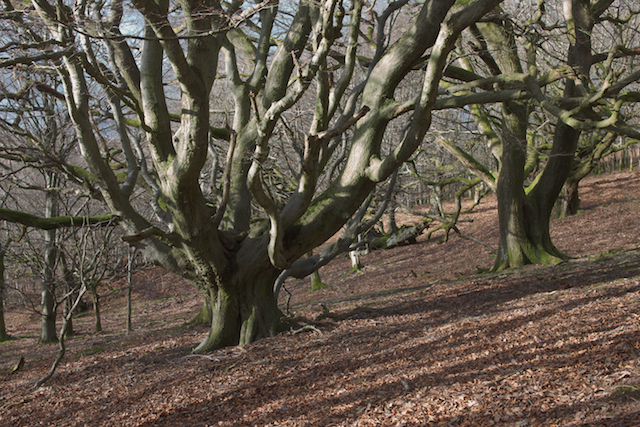
Pollarded beech (Fagus sylvatica) and oak (Quercus petraea)


All in all it was a good trip with some welcome low angled light, weather, some fresh air and some much needed exercise.

Friday, 24 November 2017

An autumn narrative

A forecast of rain clearing with some brief intermittent sunshine and low winds before a more extensive weather front arrived presented the opportunity for a quick outing to simply capture autumnal colour in the woodland of the Forest of Dean. Wetted trunks of beech trees and leaves with contre jour lighting would be just the ticket. So a 10 min car journey, 10 minute walk from the car, set up, wait a few minutes for a break in the cloud and hey presto.


Saturday, 18 November 2017

"The best laid plans of mice and men often go awry"

Overnight accommodation was booked to enable two days of photography in the environs of the upper Tywi catchment in the Cambrian Mountains. On the journey there plenty of stunning autumnal colour was passed until entering the Twyi valley, where irrespective of the woodland facing aspect or elevation the majority of oak trees were bare of leaves. Hopes of images capturing valleys mantled with autumnal oak canopies juxtaposed against open moorland were shelved for another year. C'est la vie.


The first day was leaden skies. negligible wind and 'damp' so photography ambitions were instead lowered to riparian woodland and the morphology of oak trees contorted by past events and the necessity for leaves to access sunlight. Considering the morphology and growing habitat some of the trees must be of some age.


High annual rainfall, high humidity, relatively low levels of atmospheric pollution and ancient woodland creates an ideal habitat for epiphytic bryophyte and lichens, so the opportunity was taken to photograph some of the more accessible communities.

Barnacle lichen (Thelotrema lepadinum) and Tamarisk Scalewort (Frullania tamarisci)

Crottle (Parmelia saxatilis)

The sunset vigil was spent above the tree line and hopes of a sunset were briefly raised by breaking cloud on the western horizon and then dashed as the breaks closed. Nevertheless the time spent waiting allowed an appreciation of the surrounding plateau surfaces dissected by valleys and exposed bedrock indicated folding on the northern flank of the Tywi Lineament.


The following day saw the wind increase and the weather forecast predicted cloud would briefly break up before closing, a circuitous walk through the woods and up onto the plateau was opted for. The plateau surfaces posed their usual photography challenge: a distinct lack of inspiration, so photography efforts were concentrated down on the plateau slope edge where woodland was naturally regenerating.


The cloud did eventually break up allowing fleeting patches of sunlight to play over the landscape, frustratingly though never the foreground and middle ground simultaneously during a tactical 'rest stop'. Back down in the valley and a viewpoint was chanced upon that I thought held some potential and then discovered the sun didn't quite clear the ridge, sigh.


With incoming cloud negating sunset, there ended the photography and yet another location to put on the list of places to return to one day.


Saturday, 4 November 2017

Reflected and diffuse autumn light

Heavily shaded woodland environments benefit hugely from the illumination of an autumnal canopy that imparts 'warm' light and if a mist is rising then the light is diffused. The combination creates some very special lighting and is generally utilised for photographs of sun beams penetrating through breaks in the tree canopy.


A recent trip to a Scowles woodland was rewarded with the conditions and atmosphere for reflected and diffused lighting, that made venturing forth down into the darker realms a realistic photographic ambition. The lower perspective offers views of outsize tree roots flowing down over bedrock outcrops to form buttresses and the underside of gnarled veteran beech coppice stools with rot hollows that provide insight to their great age. The dense shade and higher humidity also creates the habitat for luxuriant mosses and bryophytes and for my aesthetic tastes the emerald greens contrasts well with the freshly fallen autumnal beech leaves. Whilst sun beams breaking through a canopy provide visual drama, it is well worth bearing in mind that the very same atmospheric conditions can be utilised to photograph more challenging subject matter.

Monday, 16 October 2017

Early autumn in a Scowles woodland.

Autumnal colour in woodlands is a personal highlight in the landscape photography calendar and it usually heralds an invigorated jet stream lining up vigorous weather systems at the UK, sigh. So it was with some relief that a calm weather forecast coincided with beech leaves starting to change colour and a trip was made to a scowles woodland in the Forest of Dean. The woodland canopy is dominated by beech with yew dominating the understorey and occasional ash, holly, hazel, wych elm, whitebeam and lime. Beech trees in the ancient woodlands I am familiar with, rarely synchronise their autumnal colour. Instead it's a gradual roll out with a spectrum of hues from green to fiery orange/red and corresponding leaf fall punctuated by heavy falls in stormy weather. The colour hues shifting from greens to full autumn colour as the days shorten and nights lengthen.


On this visit there was enough early leaf fall to enliven the floor and enough leaves remaining to maintain a closed canopy and include some of the tree crowns in a composition. Some light rainfall had wetted surfaces to saturate colours and overhead cloud provided diffuse lighting. More importantly there was almost negligible wind as the composition hinges upon the lack of movement during a long exposure.  Suffice to type that I was satisfied with the photographic reward.

Saturday, 14 October 2017

Killarney National Park - 2


Due to a “series of disasters” Ireland has one of the lowest land coverage % of woodland in Europe and even then a depressing area of that is under commercial forestry of alien trees. The oak woods in Killarney National Park represent a significant percentage of the remaining native oak woodland and are designated as a Special Area of Conservation.

The Killarney oak woods have been afflicted by the Victorian era enthusiasm for alien flora and fauna that saw many exotic trees planted including rhododendron and Sitka deer introduced for sport shooting. Unusually for conservationists they are in unanimous agreement that Rhododendrons and Sitka deer are not desirable for native woodland regeneration. The eradication of rhododendron from the native woodland is an ongoing affair undertaken by commendably enthusiastic volunteers and likely to take many years. Google satellite isn't much use either as rhododendrons form an understorey and what may appear to be broadleaved woodland from above is an impenetrable wall of rhododendrons as an understorey. Additionally in an effort to regenerate the woodland, exclosure fences have been erected to keep out the Sitka and native Red deer, the exclosures do not appear to have entrance gates for visitors. Nonetheless the woodland sans exclosures and rhododendrons is worth seeking out.


There appear to be several generations of oak trees with veteran pollards and coppice stools interspersed amongst maiden trees, pointing to changes in historic woodland management. In some areas a case could be made for natural regeneration, whilst in other areas the regular spacing of oaks in linear arrangement indicates plantations.  Much of the older oak woodland in the Forest of Dean originated from Napoleonic plantations for naval ship timber and oak morphologies in the Killarney woods bear a striking resemblance to the Dean oaks.


The Lusitania flora was also chanced upon, notably the Strawberry tree (Arbutus unedo) and Saint Patrick's Cabbage (Saxifraga spathularis).

Fruits of the Strawberry tree (Arbutus unedo)


St Patrick's cabbages (Saxifraga spathularis) epiphytes on a veteran oak pollard.
The lichen communities are well represented.

Green satin lichen (Lobaria virens)

Tree Lungwort (Lobaria pulmonaria) and Green satin lichen (Lobaria virens)

There are also some fine viewpoints in the woodlands offering more expansive views.


Killarney makes a great base for exploring the National Park and I can thoroughly recommend it.