Showing posts with label trip report. Show all posts

Tuesday, 10 July 2018

Graian Alps (Alpes grées) trip report -1

Back in 2014, the last week of June was spent exploring one area of the Graian Alps and very impressive it was too. The benefits of staying in a refuge allowed dawn and dusk photography sans the drama of ascent/descent in head torch light, the wild flower meadows were in full bloom as were alpine flowers on higher ground. Some relatively accessible routes to higher vistas were recced for future visits and those with high potential noted for a future visit.
Periglacial relict blockslope and glaciated mountains
Four years on and time for a revisit with an itinerary that involved staying in a couple of refuges to maximise dawn/dusk opportunities, wet weather itineraries in the side valleys with melt water torrents and multi coloured boulders, the best photographic set aside for a couple of trips to 3,000 metre peaks, sunny weather for wild flowers, geomorphology and geology. I had also been aware of reports of heavy snowfall in the Alps throughout the winter of 2017/18. A hotel had been initially booked in a central location and from this a series of recce's would be made to establish what condition the higher elevations were in, before moving on.

Avalanched snow blocking the path
It became apparent that snow was still lying to some depth and extent at higher elevations on north facing aspects, though not so much on south facing aspects. Rivers and streams were swollen with melt water. Also evident were avalanche debris of snow, trees and rock, the smell of pine resin downwind of an avalanche tract was to become a good indicator of difficulties ahead in some side valleys. Some minor roads were still blocked by avalanche debris and one road closed as a section and slid down the mountainside. On the approach road to a high pass an impressively large loading shovel was on duty clearing the road of rock debris as it melted out from avalanche cones, elsewhere construction operations were effecting repairs to roads.  Routes to two high refuges and the way forward to high cols raised the bar for adventure beyond our comfort zone and Nic was more than happy to base our stay in the hotel for the duration, it's a hard life.

The odd cloud according to the weather forecast
Whilst the French IGN 1:25,000 maps are very good, the weather forecasts were decidedly poor: thunderstorms never materialised, neither did rainfall, cloud cover was a lottery and the temperatures much higher than forecast e.g mid 20's turned into mid 30's. With numerous caveats out of the way the next post will concentrate on the good things.

Saturday, 19 May 2018

Ramsons carpets

Two recent woodland trips provided the inspiration for this post on ramsons (Alium ursinum). The first trip was an afternoon recce for some uncommon woodland flora when a visually compelling ramsons carpet was chanced upon in less than ideal lighting. Another location identified and added to the seemingly ever lengthening 'to visit under more idealised lighting' list.


To increase the chances of finding ramsons carpets an appreciation of their ecology is useful and a Hungarian research paper provides some useful insight into the habitat requirements amongst other things:
"In spite of its broad distribution across continents, and its occurrence as a weed, the species cannot be considered as a generalist. Several authors have classified it as a habitat specialist, having a rather narrow range of ecological tolerance (Grime et al. 1988, Kevey 1977, Rychnovská and Bednář 1998). A. ursinum is particularly sensitive to the availability of water. It requires a mesic soil, which is well-drained. Both drought and waterlogging are unfavourable (Csiky et al. 1999, Grime et al. 1988, Kevey 1977, Rychnovská and Bednář 1998, Trémolières et al. 2009, Tutin 1957). Sufficient humidity in the air is also crucial for survival (Kevey 1977, Kovács 2007)."
"The species strongly prefers the forest floor; it can rarely be found outside of a forest (Grime et al. 1988), only in some places with high, evenly distributed precipitation (Tutin 1957) or along rivers or streams (Kevey 1977)." 
"The plant requires a nutrient-rich soil (Tutin 1957)"
"A. ursinum is sensitive to the pH, missing from base-poor sands and mor soils (Tutin 1957). Falkengren-Grerup and Tyler (1993) demonstrated experimentally that mor (pH 3.6) inhibited the production of new roots. Tutin (1957) estimated the tolerated pH range from 5.5 to 7.9; Grime et al. (1988) narrowed it to 6–7.5" 
Extracts taken from Oborny, B., Botta-Dukat, Z., Rudolf, K. and Morschhauser, T., 2011. Population ecology of Allium ursinum, a space-monopolizing clonal plant. Acta Botanica Hungarica, 53(3-4), pp.371-388.
Ransoms are an indicator species of ancient woodland and some online detective work cross referencing national ancient woodland inventories e.g. Wales and England, against a relevant geology map will identify candidate sites of ancient woodland overlying calcareous bedrock. It is then a case of recceing the candidate woods.


The second trip was one made specifically to photograph a riparian carpet of ramsons within the Lower Wye Valley AONB on a rare day with overcast skies, the weather in May, thus far, has been mostly clear blue skies and sunshine. The woodland is designated as ancient semi natural and has outsize coppice stools of alder, ash, wych elm and hazel with a ground flora community of ancient woodland indicator species.

Tuesday, 15 May 2018

A spring woodland trip

A forecast of heavy overnight rain with clearing skies, negligible wind and the chance of mist, was the inspiration to set the alarm clock for a dawn outing. A bluebell wood recced on an evening visit a few days before would be the destination.
Wild boar foraging


Entering the wood just before sunrise and it became apparent that a) there was no ground mist, nor indeed any other type of mist and b) a sounder of wild boar had descended en masse to forage in the bluebell carpet in the area of wood that I wanted to photograph. Sigh. There were no signs of leaves or flower stalks sans bulbs, the boar seemed interested in something else and the bluebells collateral damage. Taking stock of the situation and the overnight rain had enlivened the mosses, wetted the leaf litter and the wind was negligible, so Plan B would be a visit to a scowles woodland 10 minutes drive away and hopefully the flora would be in flower.

Ramsons carpet

On the drive to the scowles wood I passed by patches of ground mist on fields and on the walk in there was a ground mist in the meadow adjacent to the wood. No mist in the wood though and reinforcing my view that woods have their own microclimate. Nevertheless there was some nice mist filtered light over a ramsons carpet and also deeper into the wood.


The Ransoms whilst in full flower at the wood edges were only beginning to flower in some parts of the wood where beech trees had leaf flushed well before the other canopy trees of lime and ash.

In the scowles where yew forms the understorey then it's the domain of bryophyte communities and just a few vascular plants.


It did appear to my eyes that where a canopy gap allowed morning sunlight onto the woodland floor there was a noticeable increase in woodland plants.


The light all too quickly became too harsh for effective photography and the remainder was spent investigating the wood for less common plants and enjoying the chorus of bird song.


Thursday, 22 March 2018

A circuit in the Black Mountains

After a grim period of weather the Met Office served up a compelling weather forecast for a wander onto the hills.


Taking into account the wind direction, likelihood of showers and sunset light, the Black Mountains were chosen and a circuit of Cwm Banw. Nic was enthused enough to accompany me. Ascending through the fields a local farmer was met and a brief chat about the impact of Storm Emma elicited that about 2 feet of snow had fallen and drifted to very impressive depths, all the minor roads were blocked for a few days and it had taken the farmer 15 hours to dig a route to get feed to livestock, a journey that would normally take 5 minutes. To illustrate the severity of the weather event, 2 weeks on there were still snow patches a few feet deep in the sunken holloway on the path up. Reaching the open moorland and sadly the weather changed from blue skies, fluffy white clouds and warm sunshine to more ominous looking clouds, much less blue sky and the donning of winter jackets.

Landforms and patterned vegetation in the Black Mountains


The Black Mountain environs exhibit a curious mixture of landforms from plateau surfaces that suggest relict planation surfaces 10's of millions years old to those attributable with more confidence to repeated glaciations in the pleistocene. Areas of patterned vegetation may be associated with underlying superficial deposits that have been subjected to periglacial processes. Illuminated by more desirable light these would have been more apparent and a mental note was made to revisit at a more optimal time of day and year.

Squall lighting and open moorland


The best lighting occurred on the approach to Pen Allt-mawr where foreground composition was limited to moorland vegetation and a simple demonstration on the why side lighting is preferable for saturated colour.
The approach to Pen Allt-mawr

On reaching the summit of Pen Allt-mawr the squall hit with rain quickly turning to sleet and the novelty of ice coating any exposed clothing. Nic was less than impressed. Still there were grand views to the west until the hill fog obscured everything. I raised the prospect of waiting for the squall to pass and received the look of mutiny from Nic. The planned high level exposed plateau circuit of Cwn Banw walking into wind driven sleet held little appeal and instead we made our way back to the car via a lower, less exposed route. A consultation of the OS map indicated a stream would need to be crossed and that stream would no doubt be swollen. So the return route would keep to a high level and basically contouring, which explains why several relict vegetated periglacial boulder lobes were traversed and on another day these would have presented some photographic foreground interest rather than tiresome obstacles. I feel confident in stating that this particular area is not well visited. Eventually the squall passed, hill fog cleared to make navigation easier and then a brief break in the clouds allowed some sunshine through illuminating the coed cae on the south facing slopes of Cwm Banw and the Sugar Loaf hill in the distance.

A view down Cwm Banw to the Sugar Loaf. 

The stream was easily crossed at a higher elevation whilst lower down the white water suggested very high water flows and probably a more challenging crossing. We made it back to the car just before another squall arrived, a good end to the trip and some locations to be revisited.

Saturday, 6 January 2018

1st outing 2018

Conscious of the fact that hill walking had been neglected and my fitness levels had dropped alarmingly over a slothful festive period, a trip was needed to the hills. Inspiration was provided by a weather forecast that offered some hope for quality lighting with the caveat of weather warnings and the Brecon Beacons National Park would be the destination. Travelling down the A40 to Abergavenny revealed that the higher ground was obscured by low cloud, sigh, although the cloud was breaking up over the Usk valley. The Black Mountains would offer some relative shelter and the Ffridd/Coed cae potentially the best photographic opportunities given the weather and options to go higher or lower depending on how the weather panned out.


Opting to head first to the higher ground revealed how desperate the weather was, happily common sense prevailed at the futility of making photographs in a decidedly 'fresh' wind, horizontal rain and accompanying hill fog. I later learnt that Met Office weather stations in low lying Herefordshire recorded gusts to 60 mph. So a descent to the relative calm of the Ffridd/Coed cae and a wait for some light to illuminate a magnificent derelict pollarded oak against incoming rain clouds before descending down to an area of woodland that provided an insight into the historic woodland management in the form of low cut pollards and veteran derelict coppice stools. It was then a case of waiting for sunshine to break through the clouds and illuminate the woodland against the backdrop of a dark sky.


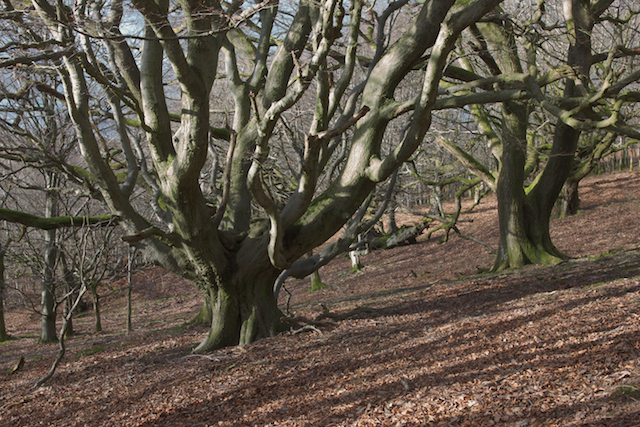
Pollarded beech (Fagus sylvatica) and oak (Quercus petraea)


All in all it was a good trip with some welcome low angled light, weather, some fresh air and some much needed exercise.

Saturday, 4 November 2017

Reflected and diffuse autumn light

Heavily shaded woodland environments benefit hugely from the illumination of an autumnal canopy that imparts 'warm' light and if a mist is rising then the light is diffused. The combination creates some very special lighting and is generally utilised for photographs of sun beams penetrating through breaks in the tree canopy.


A recent trip to a Scowles woodland was rewarded with the conditions and atmosphere for reflected and diffused lighting, that made venturing forth down into the darker realms a realistic photographic ambition. The lower perspective offers views of outsize tree roots flowing down over bedrock outcrops to form buttresses and the underside of gnarled veteran beech coppice stools with rot hollows that provide insight to their great age. The dense shade and higher humidity also creates the habitat for luxuriant mosses and bryophytes and for my aesthetic tastes the emerald greens contrasts well with the freshly fallen autumnal beech leaves. Whilst sun beams breaking through a canopy provide visual drama, it is well worth bearing in mind that the very same atmospheric conditions can be utilised to photograph more challenging subject matter.

Saturday, 21 October 2017

An autumnal small leaved lime and upland oak wood

A weather forecast for the Brecon Beacons National Park stated fog/mist/low cloud, light rain and negligible wind, so it was with high hopes that I set off for Coed y Rhaiadr, there was fog, negligible wind and light drizzle all the way there until I dropped down to Hirwaun. Where there was no fog, mist or rain and the rotating blades of wind farm turbines indicated wind too. Still there are plenty of options in Coed y Rhaiadr with autumnal colour and I headed for an area of woodland high up the ravine slopes with photogenic veteran oaks. Passing the waterfalls the area is noted for indicated the the tree canopy that provide a backdrop had been stripped of leaves from the recent passage of Storm Ophelia. The oaks I had hoped to photograph were also denuded of leaves, so it was back down to the river.


The numerous waterfalls make it a magnet for photography workshops in the autumn and it hadn't taken long for the workshop providers and punters to stake out their claims. I didn't see anyone photographing the woodland sans waterfalls, which is a pity as the woodland is designated as a Special Area of Conservation. A riparian small leaved lime in autumnal colour provided the necessary inspiration and a native woodland tree that I've rarely found a) in autumn colour and b) suitably sited to make a photograph. From the chosen viewpoint the rain serendipitously broke up the river surface, mitigating the sky reflection. Whilst waiting for the wind to ease I watched a Dipper working its way downstream, diving and feeding from the riverbed. The wind eventually died down to make a photograph and the only audible sound was rain falling and dripping down through the canopy.


Another storm was forecast in a few days time so I made the decision to maximise my photography opportunities and cut short my excursion in Coed y Rhaiadr to visit a nearby upland wood that should have been relatively sheltered from the Storm Ophelia's winds. Some parts of the wood have a closed canopy whilst other parts are more open in nature and mature sessile oaks are spread along a steep sided valley, with crowns and branches shaped by the elements. A few oaks have layered their branches which are mantled with epiphytic lichens and well within tripod height.


Birch, alder, willow, holly, hazel, hawthorn, ash and rowan trees make up the rest of the woodland trees and with more time I would have photographed these, but the oaks were concentrated on for this visit. I do not know anything of the woodlands history, many of the oaks are pollarded and the hazel trees are coppice stools, hinting at a past management regime. The wood is not officially designated as ancient woodland, but is depicted on first edition 19th Century Ordnance Survey maps and some of the oaks appear to be of some age. The lack of regeneration indicates the woodland is overgrazed and has been so for many years.


Eventually the wind and driving rain brought an end to the excursion and a note made to revisit again in the future.

Monday, 16 October 2017

Early autumn in a Scowles woodland.

Autumnal colour in woodlands is a personal highlight in the landscape photography calendar and it usually heralds an invigorated jet stream lining up vigorous weather systems at the UK, sigh. So it was with some relief that a calm weather forecast coincided with beech leaves starting to change colour and a trip was made to a scowles woodland in the Forest of Dean. The woodland canopy is dominated by beech with yew dominating the understorey and occasional ash, holly, hazel, wych elm, whitebeam and lime. Beech trees in the ancient woodlands I am familiar with, rarely synchronise their autumnal colour. Instead it's a gradual roll out with a spectrum of hues from green to fiery orange/red and corresponding leaf fall punctuated by heavy falls in stormy weather. The colour hues shifting from greens to full autumn colour as the days shorten and nights lengthen.


On this visit there was enough early leaf fall to enliven the floor and enough leaves remaining to maintain a closed canopy and include some of the tree crowns in a composition. Some light rainfall had wetted surfaces to saturate colours and overhead cloud provided diffuse lighting. More importantly there was almost negligible wind as the composition hinges upon the lack of movement during a long exposure.  Suffice to type that I was satisfied with the photographic reward.

Tuesday, 10 October 2017

Killarney National Park -1


Nic fancied an autumn break in Ireland, specifically in the South West, so a look at the map and Killarney was a good base, plenty of traditional pubs for the craic and a National Park on the doorstep. I then did some research and discovered that whilst the National Park had open access the rest of the countryside is privately owned, with very restricted access at the whim of the landowner, sigh. According to one Irish hill walking site, Eire has some of the most regressive public access laws in Europe. Further research revealed that some of the Government owned woodlands with SAC status were also closed to public access. At this point I realised the holiday itinerary would be scaled back in ambition and scope. Nonetheless, there were still plenty of hills to walk and woodland to visit.


I'll skip the hill walking bit as the weather was mostly atlantic weather fronts i.e low cloud, poor visibility and/or high winds which mitigated against visiting the loftier viewpoints, confining walking to more modest elevations and photography to views of cloud shrouded higher hills and hazy vistas.


A jewel in the crown of the Killarney NP is Reenadinna Wood, a Yew (Taxus baccata) woodland that has been extant for 3,000 to 5,000 years from palynological analysis of sediments and radiocarbon dating.


Pure Yew woodlands are a rarity and Reenadinna Wood is one of the largest, with the yews mostly growing on outcrops of Carboniferous limestone that are covered by moss. A preliminary scouting visit was made to whet the appetite and then the weather came good with a morning of rain and no wind.


The yew trees host bryophyte communities creating a pleasing juxtaposition of green and red.

A few yew trees were the habitats for lichens.


Fallen yew arils littered the woodland floor and paths exposed the yew roots tracing grikes in the limestone.


Reenadinna Wood is well worth a visit and the next post will cover the Oak woods visited in Killarney National Park.

Sunday, 20 August 2017

The vagaries of upland weather

The last two trips have perfectly illustrated why it's best to adopt a phlegmatic approach to landscape photography. The first one Nic accompanied me to Y Mynyddoedd Duon (Black Mountains) and a walk up onto and along the Ffawyddog ridge. The walking was enjoyable in warm sunshine with a cooling breeze, heather moorland in bloom and natures larder of bilberries were deliciously sweet.


It became apparent the area encompassed by the Ffawyddog ridge, Vale of Ewyas and Hatterall ridge was a magnet for clear skies, whilst trains of photogenic cloud formations rolled in from the NW further east and to the west over the Gaider Fawr ridge.

Photogenic cloud

I have no great enthusiasm for landscape photography with overhead clear blue skies due to their propensity to drain colour from a landscape and whilst black and white photography would rescue some images it holds no interest for me. When I belatedly decided to explore the moorland vegetation with a macro lens, the wind increased in strength and as sunset drew near a visibly long bank of slow moving cloud appeared to the NW that would mask the best light. The last of the sunlight was utilised for an image of photogenic cloud and then the walk back to the car unassisted by head torch light. The lack of any sunlight on distant hills confirmed the early departure was a wise decision.

The second trip had a rather enticing weather forecast of heavy showers and spells of sunshine with the wind from the SW or the distinct possibility of heather moorland illuminated by fleeting light under stormy skies and the chance of a rainbow. Except the cloud never broke up, towards dusk the rain squalls were heavy and persistent. To be fair the wind strength was spot on with winds of 30 mph (Strong breeze/near gale) and gusts to 40 mph (gale force intensity). The weather and exposed location meant I was relieved to have packed the winter jacket, over trousers and gloves.

Calluna vulgaris and Ulex Gallii

Photography ambitions were restricted to leeward ground and then ground level macro photography before rain curtailed this activity. Chatting to a hill walker descending from a nearby summit it seemed that further south, the cloud was breaking up and sunlight breaking through, this kept me enthused until it became apparent with sunset approaching that this trip would also be curtailed. So two successive trips made where the landscape photography rewards would have been very good if the locations chosen were just a couple of miles distant, c'est la vie!

Thursday, 6 July 2017

Wood of the Waterfalls

The mountain forecast indicated cloud and low hill fog, Nic fancied waterfalls and recent heavy rainfalls would ensure some photogenic water flows so a trip was made to Coed y Rhaeadr. The area provides an insight into fluvial geomorphology with steep sided ravines cut through bands of shale/siltstones/sandstone and floored by more competent sandstone. The geology is also responsible for the prevalence of waterfalls with rock competence and faults dictating their individual nature. The first photography stop was at Sgwd Ddwli Uchaf on the Nedd Fechan, where the first Dipper was seen.

Sgwd Ddwli Uchaf

Then a wander down to the confluence with Afon Pyrdin, where water levels indicated that a visit could safely be made to Sgwd Einion Gam a destination reached by a number of unassisted river crossings.

Sgwd Einion Gam

Sgwd Einion Gam

The area also falls within the Coedydd Nedd a Mellte Special Area of Conservation designated for sessile oak woods and ravine woodland, with the topography, underlying geology and superficial deposits determining the mixture of trees in the woodlands.  With the trees in leaf small leaved limes were evident and took the form of derelict coppice stools of some age. The area has a moderately oceanic climate that combined with a closed tree canopy and high levels of humidity, provide a habitat for bryophytes and ferns. Both oak ferns and beech ferns were present along the banks of the Afon Pryddin.

Oak ferns (Gymnocarpium dryopteris)

Beech ferns (Phegopteris connectilis)

A carpet of enchanter's nightshade also indicated the habitat of a closed woodland canopy and moist soil conditions.

Enchanter's nightshade (Circaea lutetiana)

The trip was a rewarding one, with plenty of interest along the way and further insights gained into the flora and landscape.

Wednesday, 14 June 2017

Shades of green

Persistent rain and almost negligible wind provided the necessary inspiration and motivation for a late spring photography trip to a scowles woodland. Whilst I have written about the benefits of rain wetted surfaces elsewhere in this blog, an additional bonus of heavy rain is the dampening effect on the surprisingly large and diverse resident population of biting insects, that would have otherwise made photography purgatory.


The tree species tally was impressive : beech (Fagus sylvatica), oak (Quercus spp.), ash (Fraxinus excelsior), cherry (Prunus avium), rowan (Sorbus aucuparia), wych elm (Ulmus glabra), holly (Ilex aquifolium), yew (Taxus baccata, field maple (Acer campestre), hazel (Corylus avellana),  hawthorn (Crataegus spp), birch ((Betula spp.), large leaved lime (Tilia platyphyllos), small leaved lime (Tilia cordata) and wild service (Sorbus torminalis). Some trees were derelict coppice stools of considerable girth indicative of a long life span.


Having exhausted my supply of dry micro fibre towels, I made my way back to the car and chanced upon a Greater Butterfly Orchid, the first I have ever seen in a woodland and the end to a satisfying outing.