Thursday, 1 March 2018

The first day of Spring, the 'Beast from the East' and Storm Emma.

The weather for the 1st day of meteorological Spring makes for grim viewing with much of the UK gripped by a blast of air from Siberia and Storm Emma arriving from the South West.

The Brecon Beacons


Windchill

The Cairngorms in Scotland
screen shot from https://www.metoffice.gov.uk/public/weather/mountain-forecasts 
screen shot from https://www.metoffice.gov.uk/public/weather/mountain-forecasts


screen shot from https://www.metoffice.gov.uk/public/weather/mountain-forecasts
Definitely a day to spend by the fireside and watch the carnage unfold on the 24hr news.


Monday, 26 February 2018

An east wind is no good for man nor beast.


The weather forecast for the Brecon Beacons National Park was:

Screen shot from Met Office https://www.metoffice.gov.uk/public/weather/mountain-forecasts/brecon-beacons

The windchill of -10C at 600m something to consider.

Screen shot from https://www.metoffice.gov.uk/public/weather/mountain-forecasts/brecon-beacons


Nic was suitably enthused by the forecast that she decided to accompany me with the enticing prospect of a good walk with late light illuminating the bleached moorland vegetation, rock outcrops and a possibility of twilight alpenglow. A check on other forecasts indicated the wind might well be stronger than the met office forecast and before leaving a check on the visible satellite imagery indicated there was cloud moving across the park from the east. The trip destination would be decided en route determined by the prevailing weather with the Black Mountains, Brecon Beacons and Fforest Fawr all in play. At Abergavenny the Black Mountains were ruled out by cloud and haze. From the highpoint of the A465 the visibility was excellent and the wind very 'fresh', ruling out the Brecon Beacons. Fforest Fawr would be the end destination. The walk was delayed waiting for a helpful farmer to pull the car from less firm ground, sigh, wheel mats under the tyre had proved useless.  However if you were going to get stuck, then this was a good place and time, sheltered from the wind, views, warm sunshine to bask in and a road only used by the farming community who were pro-actively preparing for a sustained cold blast of air from Siberia. After heartfelt thanks and lightening my wallet to reward the good samaritan farmer, I managed to park the car on more firmer ground, not my finest hour and Nic was less than impressed.

Exposed moorland, Devonian sandstone glacial erratic, limestone pavement, sink holes and haze.


Finally underway and on reaching the exposed moorland the wind was a tad stronger than expected, the windchill very noticeable, haze obscured views of the Brecon Fans and haze/cloud bank on the western horizon scuppered any hope of sunset light or alpenglow. A small positive was that the peat bogs were frozen.  A place of relative shelter was sought near a viewpoint and a cunning plan concocted. The plan involved minimising exposed walking and maximising taking in the views from sheltered sites, whilst basking in the warmth of sunshine.

Google satellite view illustrating the density of sink holes.
The area has one of the highest density of sink holes (dolines) in Britain and the geology of limestone, limestone overlain by quartz arenite sandstone and areas mantled by glacial till and peat, means there are good expressions of many sink hole types.

Sink hole (doline) types. Illustration from http://www.bgs.ac.uk/caves/sinkholes/home.html


To successfully photograph the extent of the sink holes requires very low angled side lighting and not for the first time the desired lighting failed to materialise at this location. Nevertheless there were views and limestone pavement to offer some foreground interest and relief from late winter moorland vegetation.


A good walk, decidedly fresh air, geology interest and some moorland visited which would otherwise have been overlooked in better weather.

Wednesday, 21 February 2018

The attrition of hill walking.

Probably the best book on hill walking I have read is the "The Black Cloud, Scottish Mountain Misadventures 1928-1966" published in 1993. The Introduction sets the scene and importantly covers the effects of severe weather and hypothermia on human physiology, factors that directly contributed to fatalities in 5 of 7 misadventures covered in the book:

1928 - Baird and Barrie in Gleann Einich
1933 - MacKenzie and Ferrier on Cairn Gorm
1934 - Norman MacLeod on Ben MacDui
1951 - Death and Survival at Corrour
1959 - The Loss of Five Men on Jock's Road

The misadventures have been thoroughly researched, with expert opinion sought on the prevailing weather conditions and accounts presented from the survivors and representatives from volunteer search parties. Where no witnesses survived or memories obfuscated by the effects of hypothermia, trauma and time, plausible scenarios are explored and the most likely narrative put forward. Fatalities in 5 of the misadventures resulted from the capricious nature of weather, poor judgement and those fated to be in the wrong place at the wrong time. The combination of wet clothing, high windchill, fatigue and low morale appears to accelerate the effects of hypothermia and death occurs in a matter of hours as indicated by the tragedies at Corrour and Jock's Road. The misadventures occurred well before the advent of fairly reliable mountain weather forecasts, freely disseminated information on the internet for hill walking safety and relatively affordable technical outdoor gear. Sadly there still seems to be a reluctance by some individuals to make themselves fully aware of the potential for a misadventure whilst hill walking before setting out.

Hills in winter condition
Grough reports on UK outdoors news and winter 2017/18 highlights the rescue of some very fortunate individuals.

Yorkshire Three Peaks walker found suffering hypothermia on Ingleborough
https://www.grough.co.uk/magazine/2017/12/24/yorkshire-three-peaks-walker-found-suffering-hypothermia-on-ingleborough
"A lost walker attempting the Yorkshire Three Peaks challenge was found suffering from severe hypothermia on a fell top by rescuers."
Map omission 'could have cost lost Cairn Gorm climbers' lives'  https://www.grough.co.uk/magazine/2017/12/28/map-omission-could-have-cost-lost-cairn-gorm-climbers-lives
“Despite having the best of gear, this simple omission could have cost them their lives. Nowadays mountaineers spend huge sums of money on tremendous gear, but it’s the few quid spent on a basic map and compass that is often the best investment.”
Ill equipped hypothermic Dartmoor walker 'very lucky' to be found by rescuers
https://www.grough.co.uk/magazine/2018/01/23/ill-equipped-hypothermic-dartmoor-walker-very-lucky-to-be-found-by-rescuers
“She had no map or compass, no spare clothing, was dressed in jeans which were totally inadequate for both the terrain and weather conditions and certainly contributed to her situation and mild hypothermia." 
Lost Blencathra walkers' lack of compass 'could have had serious consequences'
https://www.grough.co.uk/magazine/2018/02/13/lost-blencathra-walkers-lack-of-compass-could-have-had-serious-consequences
"The group was caught in bad weather without navigation equipment on Tuesday on the summit of the mountain."
The risks to the volunteers of the Mountain Rescue Teams attending call outs in rescuing the feckless are also reported on:

Helmet saves rescuer from serious injury after incident on Tryfan
https://www.grough.co.uk/magazine/2018/02/04/helmet-saves-rescuer-from-serious-injury-after-incident-on-tryfan


Monday, 5 February 2018

The clean air of Coed-y-Rhaeadr

After days of wind and rain the weather forecast offered something quieter, still blanket cloud but with the wind easing.  Coed-y-Rhaeadr would be worth a visit with high water flows and there's also something of interest as the area is covered by the Coedydd Nedd a Mellte SAC designated for its old sessile oak woods and ravine woodland. Parking up and a group of walkers arrived back from their outing and were coated with mud to their knees, indicating the paths were in a poor condition.  The enthusiasm for a walking mudfest wasn't that great, so a walk  was made to an area with less footfall i.e sans waterfalls and one that straddles the geological boundary of Carboniferous sandstones (quartz arenites and conglomerates) and underlying limestone lithologies.

Coppiced oak and pollarded beech tree.

The geology also influences the flora with oak, hard fern (Blechnum spicant), common hair-cap moss (Polytrichum commune) indicating sandstone bedrock, whilst ash, wych elm and sycamore indicate limestone bedrock.
Veteran pollarded sycamore adjacent to a derelict track.


Within the woods there is also evidence for past habitation with long abandoned derelict trackways leading to equally derelict buildings. One substantial pile of rubble was intimately associated with several mature pollarded sycamore trees (neophytes) playing host to a visually impressive covering of native epiphytes including polypody ferns, bryophytes and macro-lichens. A nearby veteran ash tree trunk provided suitable habitat for an old growth forest lichen - Peltigera horizontalis.

Peltigera horizontalis

The attrition of wind and recent snowfall had brought down plenty of lichen covered twigs, branches and trees and in one area a beard lichen - Usnea Florida was conspicuous on the woodland floor and high up in the canopy. A lichen indicator of very low levels of atmospheric pollutants.

Usnea Florida


With dusk approaching the walk was cut short and the end to an interesting wander.

Tuesday, 30 January 2018

Beech - Fagus Sylvatica

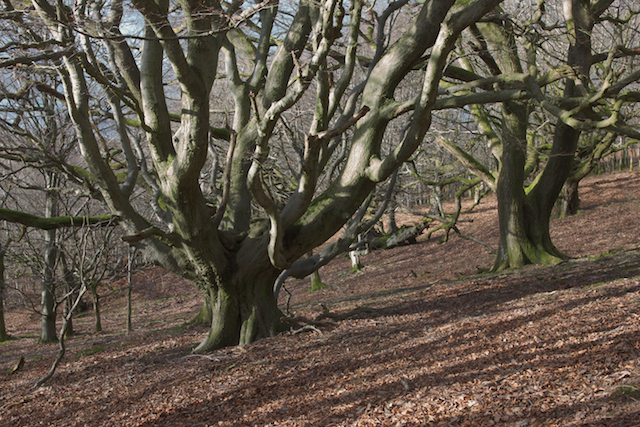
Derelict beech pollard, Black Mountains
On a recent trip to the Black Mountains I passed by a number of impressively large derelict beech pollards that reminded me to look up the latest research into unravelling the history of beech in the British Isles. There was once a time when beech was believed to be native only to southern England. This paradigm has had to be revised in light of beech charcoal excavated by archaeologists in secure contexts and beech pollen found in waterlogged sediments viz drowned forest beds in the Severn estuary radiocarbon dated to around 6,000 years ago. The late Oliver Rackham produced a distribution map for beech in the New Naturalist Woodlands  and it has been reproduced in a comprehensive monograph on beech Packham, John R., et al. "Biological flora of the British Isles: Fagus sylvatica." Journal of Ecology 100.6 (2012): 1557-1608 

Presumed distribution of beech (fagus sylvatica) from Packham, John R., et al. "Biological flora of the British Isles: Fagus sylvatica." Journal of Ecology 100.6 (2012): 1557-1608.
A google search threw up the news that research had established that beech in Scotland was native in origin.


Moving onto Google scholar and finding anything related to recent research publications - with open access - on beech colonisation in Britain has proved challenging, vague generalisations seem to apply. All the current research seems to be centered on mainland Europe. Beech is apparently a thermophile and is used to reconstruct and model quaternary environments and with a widespread European distribution underpins some avenues of research. There are a plethora of papers attempting to model the distribution and colonisation rates of beech across Europe during the pleistocene/holocene and seems to entail postulating numerous glacial refugia. The glacial refugia influence the rate of colonisation, with increased rates to account for the bypass routes around significant mountain ranges, where colonisation rates are improbably high then alternative hypotheses need to proposed such as: beech mast transported by northward flowing rivers, animal dispersal, anthropogenic assisted distribution etc. One notable paper provides compelling evidence from radiocarbon dated pine, oak and beech charcoal, possibly indicating a glacial refugia in the Harz mountains and poses some interesting questions of colonisation and climate models Robin, Vincent, et al. "Too early and too northerly: evidence of temperate trees in northern Central Europe during the Younger Dryas." New Phytologist 212.1 (2016): 259-268. The paper provoked a comment and a reply. An interesting exercise and an insight into an ongoing area of much debate.

Saturday, 6 January 2018

1st outing 2018

Conscious of the fact that hill walking had been neglected and my fitness levels had dropped alarmingly over a slothful festive period, a trip was needed to the hills. Inspiration was provided by a weather forecast that offered some hope for quality lighting with the caveat of weather warnings and the Brecon Beacons National Park would be the destination. Travelling down the A40 to Abergavenny revealed that the higher ground was obscured by low cloud, sigh, although the cloud was breaking up over the Usk valley. The Black Mountains would offer some relative shelter and the Ffridd/Coed cae potentially the best photographic opportunities given the weather and options to go higher or lower depending on how the weather panned out.


Opting to head first to the higher ground revealed how desperate the weather was, happily common sense prevailed at the futility of making photographs in a decidedly 'fresh' wind, horizontal rain and accompanying hill fog. I later learnt that Met Office weather stations in low lying Herefordshire recorded gusts to 60 mph. So a descent to the relative calm of the Ffridd/Coed cae and a wait for some light to illuminate a magnificent derelict pollarded oak against incoming rain clouds before descending down to an area of woodland that provided an insight into the historic woodland management in the form of low cut pollards and veteran derelict coppice stools. It was then a case of waiting for sunshine to break through the clouds and illuminate the woodland against the backdrop of a dark sky.


Pollarded beech (Fagus sylvatica) and oak (Quercus petraea)


All in all it was a good trip with some welcome low angled light, weather, some fresh air and some much needed exercise.

Tuesday, 2 January 2018

Abstracting woodland

The last quarter of 2017 witnessed the extensive use of 100mm and 180mm macro lenses to record epiphytes at minimum focus distances in woodland environments and to avoid getting distracted from macro subject matter sometimes only those lenses were carried. So despite the good intentions the opportunity also arose to also explore abstracts of woodland subject matter and intimate views of the woodland.

180mm ~ Oak, Speech House woodland, Forest of Dean
100mm ~ Oak, Speech House woodland, Forest of Dean
100mm ~ Dead Holly, Speech House woodland, Forest of Dean
Decorticated wood was one source of inspiration and some low level light illuminating Holly berries was another.

180mm ~ Holly, Speech House woodland, Forest of Dean

Some 'epiphytescapes' were also attempted.

100mm ~ Veteran oak, Speech House woodland, Forest of Dean

100mm ~ Fallen oak, Speech House woodland, Forest of Dean
Finally on the last trip of 2017 a suitably blurred woodland background for a coral lichen coated tree trunk was chanced upon.

180mm ~ Coral lichen (Sphaerophorus globosus), Cnwch Wood, Elan Valley

The opportunity to abstract the woodland environment allowed some welcome relief from the travails of  pure macro photography and images made of subject matter that I wouldn't necessarily have made with the usual landscape lens line-up.